
The Campbell County Owner-of-Record Card
Campbell County's Real Estate guide lays out the fields that identify a parcel. It also names the parcel's tax-roll owner. Read the current owner alongside the Map ID, legal description, mailing address, situs, and deed reference. Don't read it alone. A name in the Land Book is the county's owner-of-record view, nothing more. It is not a full title opinion.
| Owner name | Tax-roll owner tied to the parcel |
|---|---|
| Map ID | County key for ownership and map research |
| Mailing address | Where tax notices are sent |
| Situs address | Where the land is located |
| Legal description | Land description used to confirm the deed |
| Deed reference | Bridge to the recorded conveyance |
| Transfer date | Check the recorded deed; the Land Book guide does not list a separate last-sale-date field |
| Land, building, total value | Assessment components in the current roll |
The situs and mailing address can differ. Neither one tells you who occupies the property. Treat the mailing field only as a lawful contact route for a property matter. Keep the Map ID at hand. Real Estate uses it to separate a similar name or an adjacent parcel from the right entry.
The Land Book guide also carries parcel size and the legal description. It lists the deed reference and separate land, building, and total values. Those details help distinguish a current owner entry from another person sharing the same name. The current-owner record is still just a tax-roll view. A newly filed transfer has to be confirmed in the Clerk's recorded deed index.
Confirming a Campbell County Current Owner
To confirm a current owner in Campbell County, set the Land Book entry beside the newest recorded deed. The county's Real Estate page publishes no refresh schedule after recording. A recent transfer can show up in the Clerk's system before the roll catches up. The deed names the parties and describes the land conveyed. The Land Book stays the assessment and tax-roll record.
Searching the deed index takes grantor and grantee names, not an address alone. Use the parcel's deed reference and legal description to pin down the transfer. The Virginia SRA page notes that index access may be free where enabled. Images can require a clerk-authorized subscription and payment.
- Read the tax-roll owner, Map ID, situs, mailing address, and deed reference in the Campbell Land Book resources.
- Use the deed reference and grantee name to find the newest recorded instrument.
- Compare the deed's legal description with the parcel description, not only its mailing address.
- If a business entity is the owner, check the SCC filing for its status and registered agent.
- Owner of record
- The name the county shows on its tax roll.
- Assessment roll
- The county's record of ownership and assessed property values.
- Situs and mailing
- Physical property location and tax-notice address.
- Recording lag
- The time between a deed filing and a change to the Land Book; Campbell does not publish a set interval.
Reaching a Campbell County Owner
For a property-related notice, the Land Book's mailing address is the right public route. It may point out of county. It may point to an entity office. Do not assume it is a residence. Do not assume an LLC filing names each person with an interest in the company.
Virginia also has protected-voter and address-confidentiality rules that can keep some residence addresses off display. If an address is withheld, leave the protection alone. Take a lawful records question to the right custodian. Do not try to route around the rule through another search.
Lawful use. Use Campbell County ownership data for a property matter or due diligence. Do not use a public name or address to stalk, intimidate, or harass anyone.
How Current Is Campbell County's Roll
How current is the roll? The county Real Estate page never states how many days or weeks pass. A recorded deed and a Land Book update may sit an unknown distance apart. Treat the roll as an assessment record that may lag. When timing matters, the newest recorded deed is the direct record of the conveyance.
Dates need care too. A deed has the day the parties signed it. It also carries the day the Clerk recorded it. The county's assessment entry changed on yet another day. The Real Estate guide publishes none of those intervals. The newest recorded instrument supplies the filing evidence. The Land Book shows what the tax roll currently carries.
If the two records show different owners, note each date and reference. Then ask Real Estate whether the roll has been updated. The mailing-address correction contact is (434) 332-9568 and realestate@campbellcountyva.gov. A response from that office settles what Campbell County currently shows. A guessed refresh interval does not.
Situs and Mailing in Campbell County
The situs tells where the parcel sits. The mailing address points to the recipient of tax notices. Campbell's guide lists both fields. They can differ for a second home or family-held land. A trust or a business address can also split the two.
Compare the Map ID and legal description when the address fields point to different towns. Different zip codes matter too. A postal Altavista or Brookneal label does not prove the tract lies inside the incorporated town. An election district does not define the town boundary either.
Campbell County Entity Owners
An LLC can sit on both sides of the record at once. It may appear as the deed grantee and the Land Book owner. A manager or member runs its day to day affairs. Virginia's SCC Clerk's Information System helps here. It lists business status, jurisdiction, principal office, registered agent, registration date, and filing history. That is an entity record, though. It does not name every beneficial interest behind the company.
Spell the legal entity exactly as the deed does, then compare against the SCC entry. Campbell County Real Estate's owner field and the clerk's recorded deed still anchor the link. That link runs between entity and parcel. Trusts are different. If the record names a trustee, no SCC lookup will surface the trust's beneficiaries.
People sometimes sign in an official capacity. An executor or trustee may convey property for an estate rather than hold it personally. Read the deed's first-page party names, vesting language, and signature lines together. The recorded file and any probate authority settle that question. They settle it far better than a business-directory match. The SCC entity search is the state filing route when the grantee is a business.
Contacting Campbell Real Estate
Campbell County's Real Estate Office keeps the Land Book, ownership listings, the map-number listing, assessments, and tax cards. Call (434) 332-9568 about mailing-address updates, or write to realestate@campbellcountyva.gov. The reassessment line is (434) 592-9568. For a present-owner question, have the parcel's Map ID and source date ready.
A recorded transfer belongs to the Clerk: (434) 332-9517, 732 Village Highway, P.O. Box 7, Rustburg, VA 24588. Virginia Courts lists clerk hours of 8:30 a.m. to 4:30 p.m. The county Real Estate page links the parcel viewer and its service details.
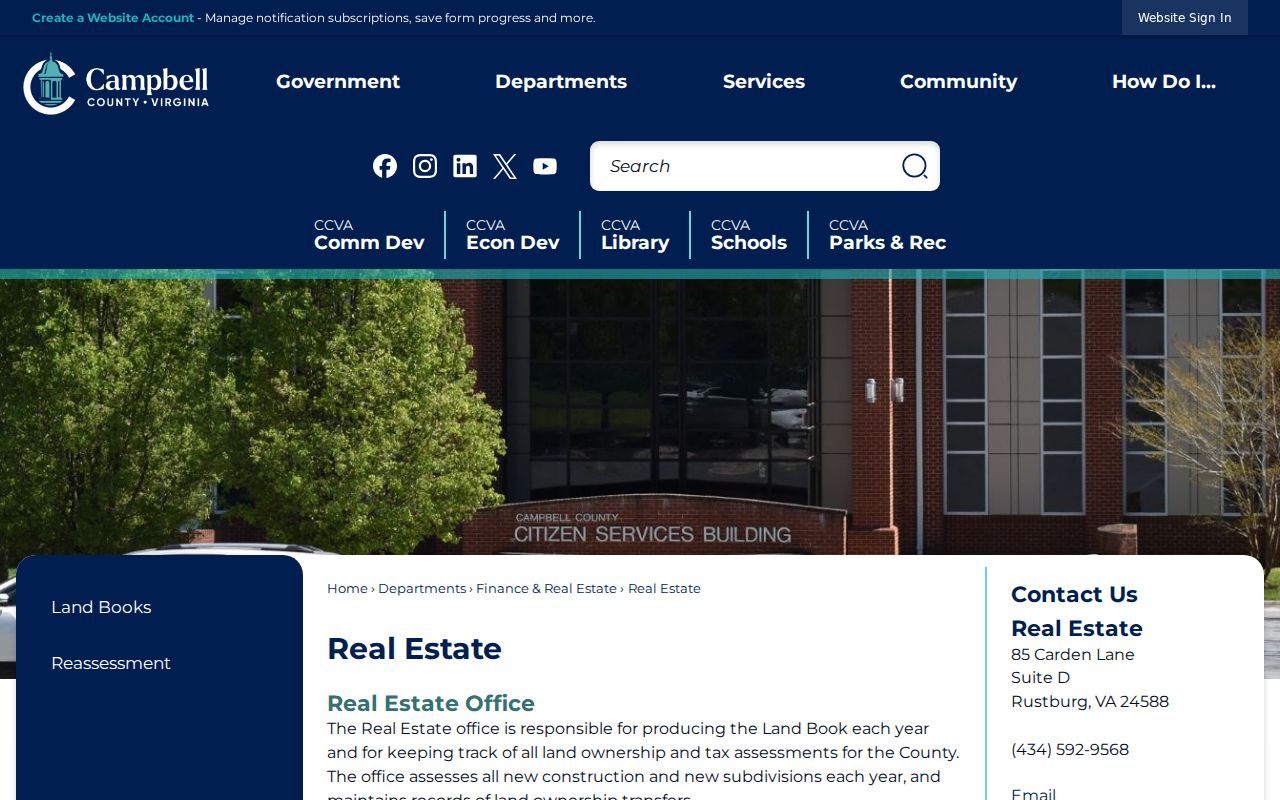
The Land Book fields on the county resource page do the heavy lifting. Match an owner name to the right parcel there.
Campbell County Deed Vesting and Co-Owners
A deed can name more than one grantee. It can also describe a trustee, executor, or other representative. Read the vesting language first. Read the full legal description too. Only then reduce the instrument to a single name, if you can. The Land Book's owner field serves taxes and parcel identification well. But it cannot spell out every shared or fiduciary interest a deed states.
For any present-owner question, set the newest deed beside the county's owner listing. Note the differences. The Circuit Court Clerk confirms recorded instruments; Real Estate explains the current tax-roll entry. Neither office's public summary is a legal opinion about co-ownership rights.
Multiple grantees demand care. Keep every name and the full vesting text in your notes. A shared surname or mailing address proves little. It cannot show whether parties own together or whether one is acting for another. For legal effect or title status, take the instrument to a qualified Virginia title professional or attorney. Ask that professional for interpretation.