
Finding Who Owns in Campbell County
Start from the address or the Map ID. Treat any owner name as a first result, not final proof. Campbell County Real Estate publishes the Land Book and its ownership listings, while the Circuit Court Clerk holds the deed recording each conveyance. When the owner is an LLC or corporation, Virginia's SCC entity filing adds a registered-agent and filing-history clue.
Keep the Map ID with every result. The legal description and deed reference matter too. Those details separate a same-name owner from a trust. This ordering answers a common address-based question without turning a tax-roll lookup into a title search.
- Locate the parcel in the Campbell County Real Estate resources and note its Map ID.
- Read the owner name, mailing address, situs, legal description, and deed reference in the Land Book information.
- Use the deed reference and grantee name to check the most recent recorded transfer through Virginia SRA or the Clerk.
- If a business is named, search the Virginia SCC entity records for its filing and registered agent.
- Use the mailing address only for a lawful property matter, not as proof of occupancy or title.
Campbell County Ownership Sources
Each source answers a different ownership question. The Land Book carries the county's tax-roll owner; the deed names the parties to a recorded transfer; GIS pins the record to a place. Their access rules and update schedules vary. Even so, all of them should agree on the parcel description.
Where Campbell County Owner Information Comes From
The Land Book supplies the tax-roll name and parcel identifiers. Campbell County's Real Estate office maintains it. The Circuit Court Clerk's grantor-grantee index documents the parties on every recorded transfer. A deed's legal description then ties those parties to the land. GIS separates one parcel from its neighbors by location. Each source answers a different question, so compare them. Use a Virginia SCC search to identify any business entity named in a deed, rather than treating one name as the whole ownership picture.
| Source | Owner Info It Gives | Access |
|---|---|---|
| Real Estate Land Book | Owner name, mailing and situs addresses, legal description, deed reference | County Real Estate resources and parcel viewer |
| Circuit Court deed index | Grantor and grantee on recorded land instruments | SRA index where enabled; images may be controlled |
| Virginia SCC entity filing | Business status, filing history, registered agent and office | SCC Clerk's Information System |
| County GIS | Map outline and location context for a parcel | GIS and 911 map viewer |
The owner of record is the party named on the tax roll or the deed. That label says nothing about occupancy. Nor does it reveal who manages an LLC or who benefits from a trust. Roll updates can lag behind a transfer. For detail on the current owner and that lag, see the current-owner explanation.
Use Real Estate for assessed owner and parcel fields. The Clerk's index instead documents the parties and terms of a specific recorded transfer. GIS resolves which parcel a result describes. It adds no owner record of its own. When sources disagree after a recent sale, compare their dates and ask the custodian which record was updated last.
Campbell County's Land Book Owner Field
Campbell County's Real Estate listings pair each owner name with a full parcel record. The Map ID, situs and mailing addresses, legal description, deed reference, and acreage appear alongside the values. The land, building, and total values sit in the same grouping. That grouping matters. A bare name can hide a trust or an entity. It can also hide a same-name owner of a different tract.
The county publishes no refresh timetable. A new deed can sit in the Clerk's records. Meanwhile the Land Book still shows the prior owner. Treat the Land Book as the current tax-roll view. After a recent sale, confirm the newest recorded deed before relying on any name.
The county's Real Estate information page describes each Land Book field. It is an office resource, not a parcel-specific owner result.
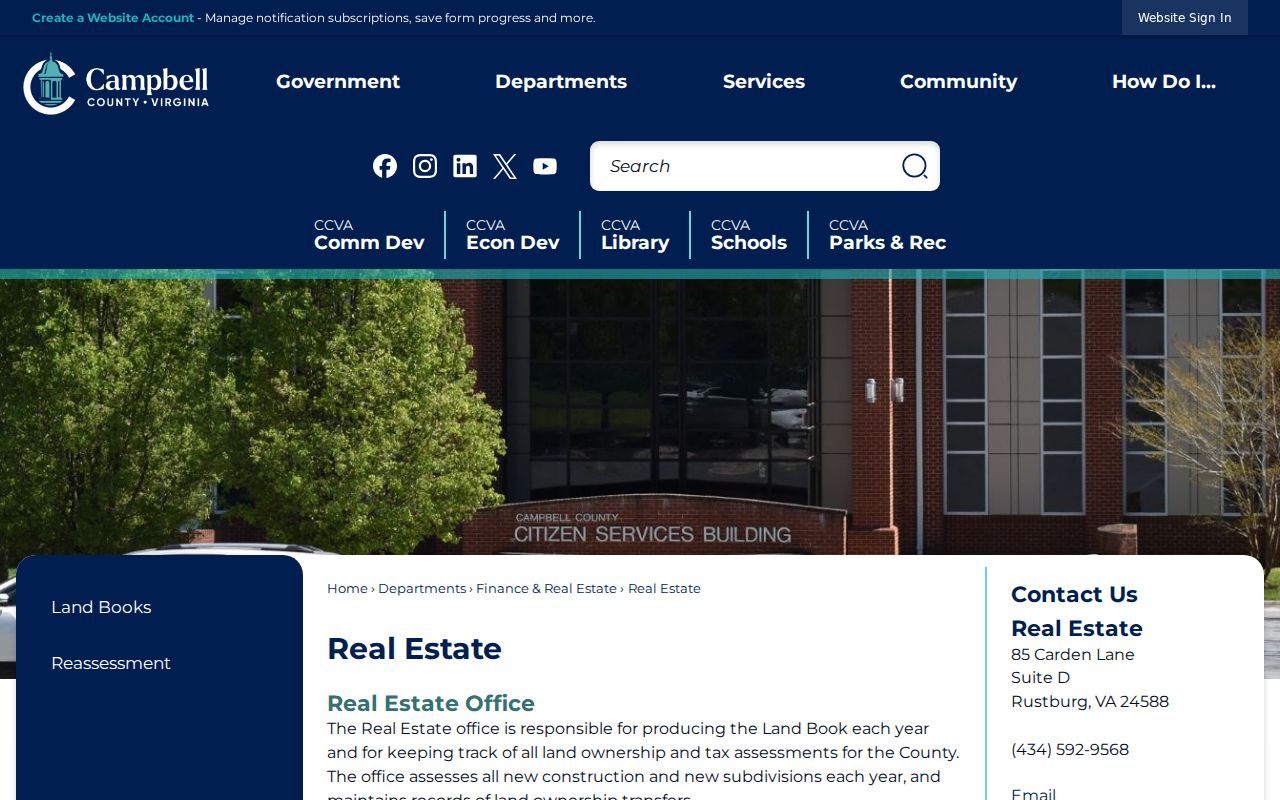
This image supports the Land Book route only. It names no parcel's current owner.
Mailing Address and Campbell County Situs
Situs is simply where the land sits. The mailing address is where a bill or notice goes. The two often differ. Owners of second homes, rural tracts, or property held through an estate or business commonly split them. A postal city like Altavista or Brookneal helps mail arrive, but it does not prove the parcel sits inside town limits.
Before sending mail, double-check the details. Compare the Map ID and legal description against the listing. Campbell Real Estate handles mailing-address corrections at realestate@campbellcountyva.gov and (434) 332-9568. A correction changes only the tax-mailing field, not the deed's legal description or the recorded ownership.
Limits of a Campbell County Owner Lookup
A public owner record names one party. It identifies whoever the county's records tie to the parcel, and nothing more. It cannot expose the beneficial interest behind a trust. Nor can it confirm that every claim to title has been resolved. A complete ownership question may require the latest deed and the legal description. Court or probate filings may also matter.
Virginia law also shields protected addresses in some records. The county owner listing is not a tool for locating or targeting a person. When a title decision matters, a records search is only a start. Qualified review must follow.
Lawful use. Use Campbell County owner information for property research, purchase diligence, or civic review. Do not use public records to stalk, intimidate, or harass anyone.
Campbell County LLC and Trust Names
An LLC can hold title in its own name. A trust usually appears through a trustee or some other vesting phrase. Neither label tells you who truly benefits from the Campbell County parcel. When a business entity shows up as grantee in a deed, the SCC Clerk's Information System can reveal its status, jurisdiction, formation or registration date, registered agent, office, and filing history. Search the entity name exactly as the deed records it. Keep in mind the SCC filing describes the business; it never guarantees a beneficial owner. The Virginia SCC entity search stands apart from Campbell's land-record index and from the parcel viewer, so use it as a companion tool rather than a substitute.
An SCC screen can help you identify a named entity. It still cannot replace the deed linking that entity to a Campbell County parcel.
Estate Transfers in Campbell County
A death changes the paper trail, not always the title. In Campbell County, the land record may shift through a will. It may shift through a qualification order, an estate sale, a partition, a fiduciary deed, or a conveyance recorded by an executor or administrator. A death certificate proves the event happened. It does not transfer property. The Campbell Circuit Court Clerk handles probate alongside land records. A complicated transfer may span both files.
Older deaths fall under Virginia Vital Records, which sets public thresholds and access rules. Certified copies generally require immediate-family eligibility, valid ID, and a fee before a record opens. Ownership still turns on the recorded deed or other controlling instrument.
The Library of Virginia catalog also lists Campbell fiduciary and commissioner records. These can show who acted for an estate or a court matter. Start with the deed reference and the current legal description. The grantor may be named as an executor, trustee, or administrator. Pull the probate or fiduciary filing next. That approach explains the chain of title without mistaking a death notice for a conveyance.
Town Address, County Owner Record
Altavista and Brookneal are incorporated towns. Rustburg is the unincorporated seat of Campbell County. The county's Real Estate, Clerk, Treasurer, and GIS resources hold the land-record layer across all of these communities. Town planning or utility offices can add local color. The county publishes no separate town recorder or assessor.
Election districts and precincts are not town limits, either. A rural property may carry a town's postal name, and a town address can sit right beside county land outside the boundary. Confirm legal situs with county GIS and the parcel record before treating a mailing label as jurisdiction.
GIS for Campbell County Owner Research
The county GIS and 911 map helps you orient a parcel and compare map outlines. It earns its keep in two cases. Two records may share an owner name, or a street address may seem unclear. The map settles nothing about title, occupancy, or exact boundary. Those questions belong to the deed, the court file, or a licensed surveyor. Campbell's GIS page also links a separate open-data hub. Use these tools to locate the land. Then compare the Land Book's Map ID, situs, and legal description before trusting the match.
Campbell County Deed Alert
Virginia Courts runs a VA Deed Alert notice for Campbell. It points residents to the Circuit Court Clerk for land-record questions. It works as a fraud-awareness route. The notice offers no signup form and promises no immediate notice for every filing. Check the official document and call the Clerk if an unfamiliar transfer appears.
For deed records, the Campbell County deed-records page walks through the index and image routes. Use the public Clerk contact rather than a solicitation demanding odd payment. Do not rely only on a QR code.